This was fun 🙂
I was hunting elk, using a cow elk call, and every time I called a (seemingly annoyed) Turkey responded. SO FUNNY!
Copyright Daniel Foucachon 2016
This was fun 🙂
I was hunting elk, using a cow elk call, and every time I called a (seemingly annoyed) Turkey responded. SO FUNNY!
Copyright Daniel Foucachon 2016
I would like to tell you something about my mother and about me. Homeschooling mothers have to be self-sacrificial, hard-working, and patient. I want to share how these qualities in my mother blessed my life in a particular way. For whatever reason (some people would affix a three or four letter acronym to this), I was just not ready to read when most boys and girls normally learn to read.
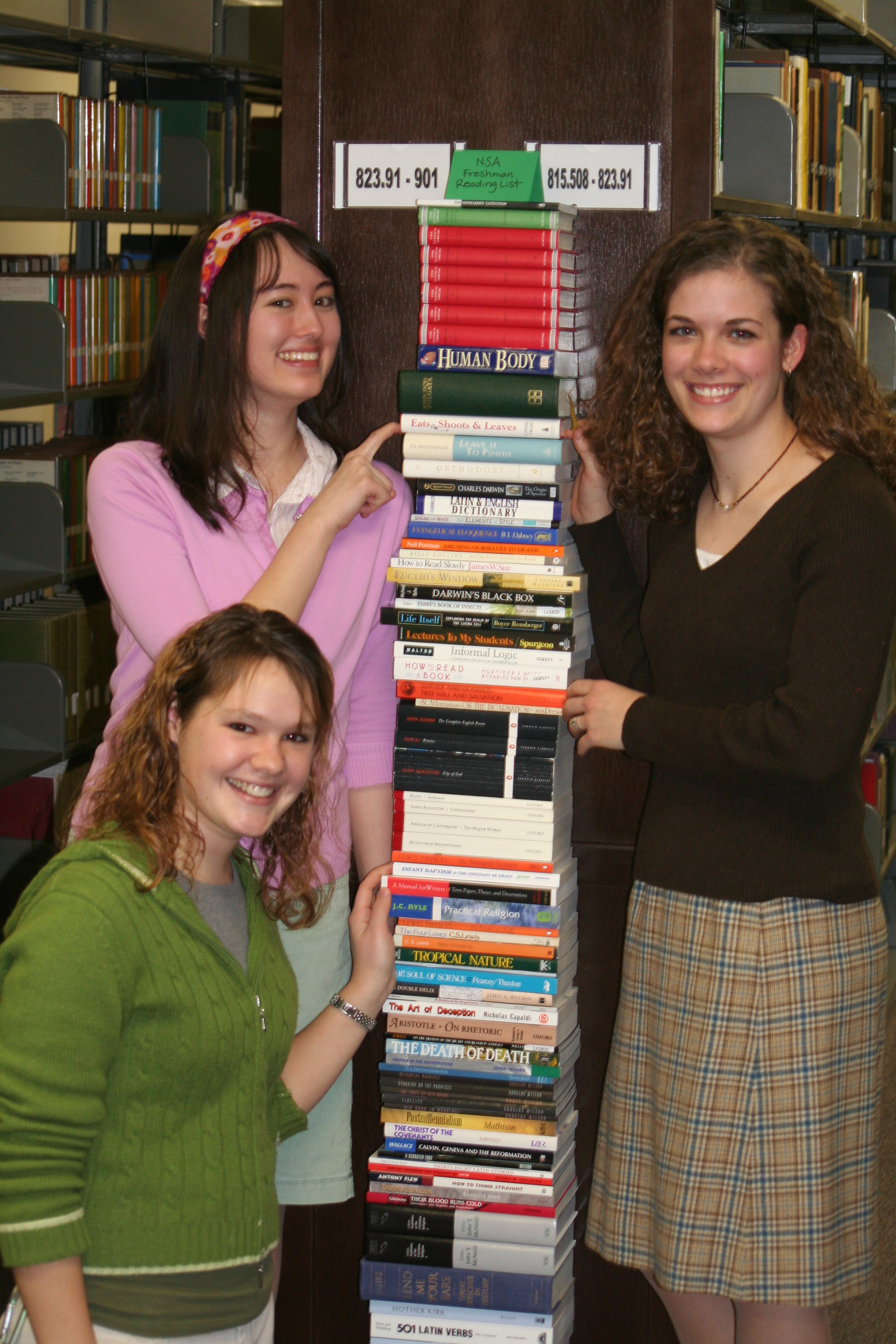
Some classmates standing beside the Freshman reading list at New Saint Andrews College
It wasn’t that she wasn’t trying hard enough, or that she was not qualified (truth be told, she graduated Summa Cum Laude from Gordon College, and taught at Winter Park High School – she is over-qualified!). For whatever reason, I simply wasn’t ready–I was just not grasping the careful and articulate lessons she taught me. She patiently continued to teach me from 6-10 years old. When I was about 10 years old everything suddenly clicked into place. I was ready to read, and took off!
Years later, I now have BA in Liberal Arts and Culture from New Saint Andrews College, a particularly vigorous program in terms of reading, requiring an estimated 20,000 pages of reading in Freshman year alone. The pile of required books every Freshman reads reach higher than the average student when stacked. And I loved it. I thrived. I am a voracious reader.
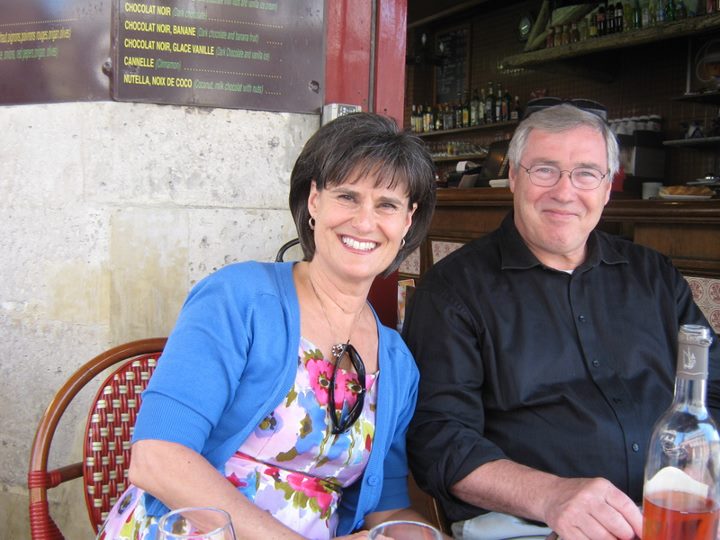
My wonderful mother, Donna Foucachon
The amazing thing, however, is not that I was late, but that I never knew it. It was only years later that I looked back and realized that most kids learned to read earlier than I did. I had no idea. And that’s when I realized just how much love and care and patience it took my mother to continue teaching me, worrying about the delay, and yet plodding on. It turned out, nothing was “wrong with me.” I was perfectly normal, and just needed time. Had I been in public school I would have been acutely aware of my “slowness.” It wasn’t easy for my mother to homeschool all 5 of us kids in 5 different grades, while also being a pastor’s wife overseas. But it was an incredible gift to me. Thank you!
Now married to another bibliophile, we are inundated with books. We have more books than our bookshelves can hold. Piles of books on every subject: fiction, history, philosophy, literature, theology, how-to’s, The Great Books, classics, etc. And we’ve read the majority of them!
If you are a parent with a late reader, don’t assume there is a problem. Obviously sometimes there can be true issues, ranging from physical, physiological, or even just plain old laziness. But I believe many children are cast into a mold that simply doesn’t fit them. When we force them into that mold, we are hurting them, not helping them. Sometimes they just need time. I did!
Daniel Foucachon,
Founder and CEO, Roman Roads Media
January 8th, 2013.
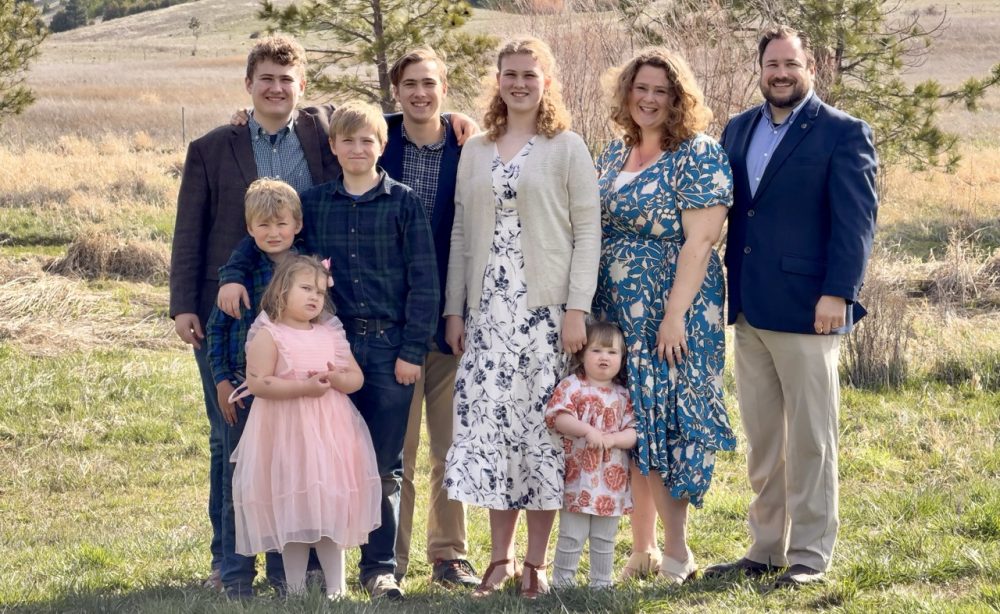
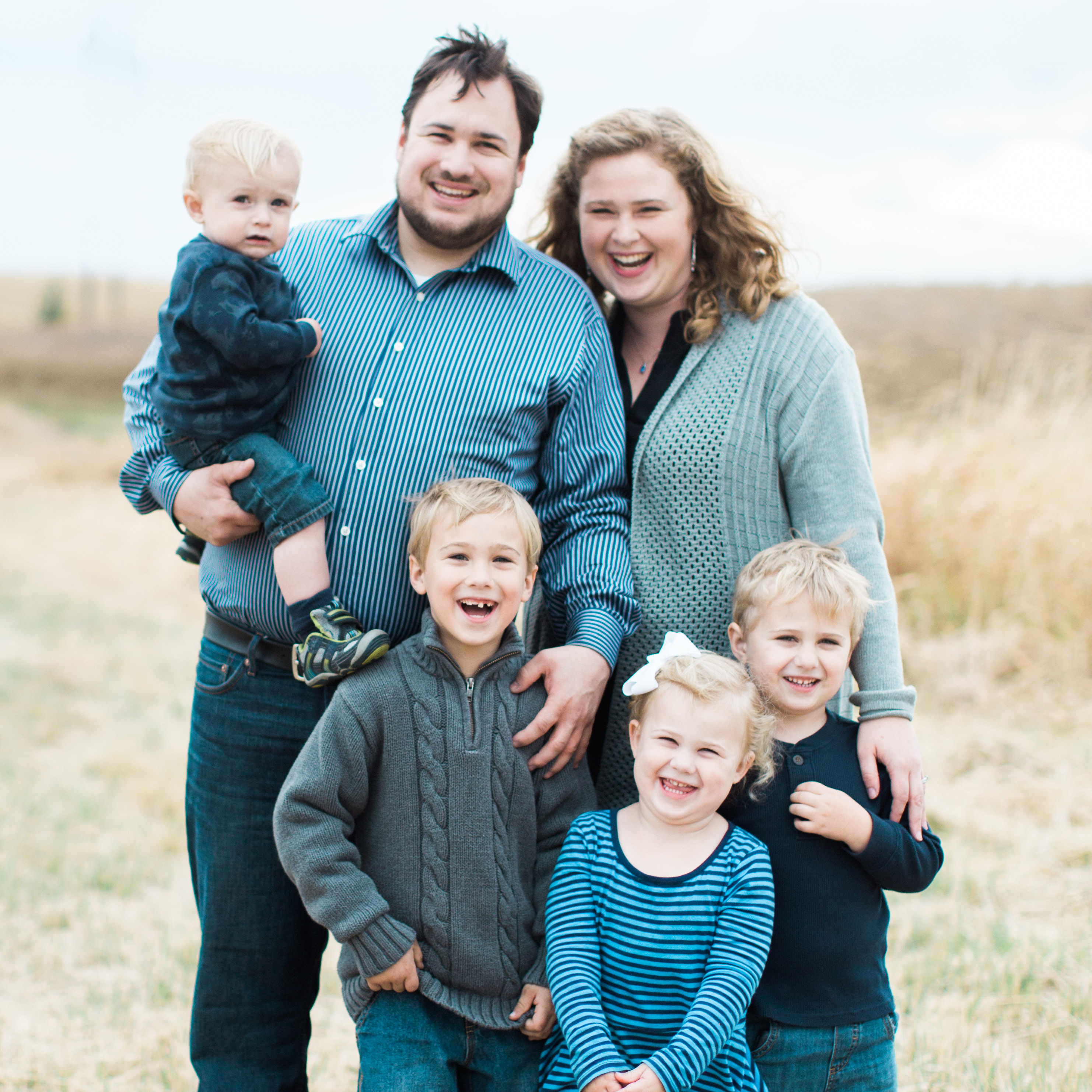 Daniel Foucachon grew up in Lyon, France where his family was church-planting with MTW. He was homeschooled for most of his education, attending a Classical Christian School for two years in Lyon. He then moved to Moscow, Idaho in 2005 to attend New Saint Andrews College, and graduated with a BA in Liberal Arts and Culture in 2009. While finishing school and working in his father’s French restaurant, “West of Paris,” he ran a local media production company where he sub-contracted with Canon Press to create CanonWired. In 2012 he founded Roman Roads Media with the desire to bring quality Classical Christian Education to the homeschooler. He now lives in Moscow, Idaho with his wife Lydia, and four kids (Edmund, William, Margaux, and Ethan).

The beautiful outdoors that surround Moscow, Idaho!


Photos by Daniel Foucachon of Moscow, ID
“According to the great Roman orator Cicero, the threefold goal of rhetoric is “to teach, to move, and to delight.” Now, these three goals line up with singular appropriateness to the three standards of truth, goodness, and beauty. Effectiveness in rhetoric can be measured against our ability to teach men the truth, to move men to goodness, and to delight men with beauty – and by beauty we mean verbal beauty, the beauty of a pleasing poem or a well-turned phrase. Effective speaking and writing is informative, powerful, and elegant.”
– James Nance, Fitting Words: Classical Rhetoric for the Christian Student (2016).
A further and rather telling example [of difference in English word origins between Anglo-Saxon and French] is the fact that the English words for many animals (such as ‘cow’, ‘sheep’, ‘boar’, ‘deer’) refer to the living creature in the hands of the farmer or herdsman, while once slaughtered, cooked and served to the Norman barony they acquire a French-based culinary name: ‘beef’, ‘mutton’, ‘pork’, or ‘venison’.
Stephen Pollington, An Introduction to the Old English Language and its Literature, 8.
Filmed by Daniel Foucachon
I recorded one of the recent Psalm Sing’s at Christ Church. Here are a few of the songs:
We assert still that the Skeptic’s End is quietude in respect of matters of opinion and moderate feeling in respect of things unavoidable. For the Skeptic… so as to attain quietude thereby, found himself involved in contradictions of equal weight, and being unable to decide between them suspended judgment; and as he was thus in suspense there followed, as it happened, the state of quietude in respect of matter of opinion . For the man who opines that anything is by nature good or bad is for ever being disquieted: when he is without the things which he deems good he believes himself to be tormented by things naturally bad and he pursues after the things which are, as he thinks, good; which when he has obtained he keeps falling into still more perturbations because of his irrational and immoderate elation, and in his dread of a change of fortune he uses every endeavor to avoid losing the things which he deems good. On the other hand, the man who determines nothing as to what is naturally good or bad neither shuns nor pursues anything eagerly; and, in consequence, he is unperturbed.
– Sectus Empiricus, in,
Landesman, Philosophical Skepticism, 39.
The kind of relativistic, un-judgmental view of life, seems to me a kind of de-creation. God created man to have dominion on all creation, and to be in a state of suspended non-judgment, not pursuing anything ardently, not ruling with any dogmas whatsoever is a kind of reversal of the dominion mandate.
"Philosophical classifications are not like labels for political parties that people officially join; at best, they point to a salient feature that systems that differ in many other ways have in common. Such groupings fail to rise to the level of natural kinds; they are closer to what Wittgenstein thought of as concepts based upon family resemblances. They should be understood as handy devices for abbreviated referenced rather than as the product of a deep analysis of a philosophical tendency.
Charles Landesman, Skepticism – The Central Issues, 2.
The reason why gramophone music is so unsatisfactory to any one accustomed to real music is not because the mechanical reproduction is bad – that would be easily compensated by the hearer’s imagination – but because the performers and the audience are out of touch. The audience is not collaborating; it is only overhearing.
– Collingwood
HT: Peter Leithart
Faculty Skit from the Class of 2009’s Last Disputatio.

Student-made promotional video for New Saint Andrews College in Moscow, ID.
Why, then, are we justified by faith? Because by faith we grasp Christ’s righteousness, by which alone we are reconciled to God. Yet you could not grasp this without at the same time grasping sanctification also. For he “is given unto us for righteousness, wisdom, sanctification, and redemption” [I Cor. 1:30]. Therefore Christ justifies no one whom he does not at the same time sanctify. These benefits are joined together by an everlasting and indissoluble bond, so that those whom he illumines by his wisdom, he redeems; those whom he redeems, he justifies; those whom he justifies, he sanctifies…Thus is is clear how true it is that we are justified not without works yet not through works, since in our sharing in Christ, which justifies us, sanctification is just as much included as righteousness.
John Calvin, Institutes of the Christian Religion, bk III, ch. 16.1
From the commonplace book of Daniel Foucachon
From Blog and Mablog:
Ascension Sunday 2009
This Lord’s Day is Ascension Sunday, the day we have set apart to commemorate the exaltation of Jesus Christ to the right hand of the Ancient of Days. This was the day upon which He was given universal and complete authority over all nations and kings, when He was given all rule and authority, dominion and power. Our Lord’s name is the name which is high above every name, and His is the name that, when spoken, will cause every knee to bow, and every tongue to confess, that He is indeed Lord of heaven and earth. And, as we cannot emphasize too much, or say too often, this is no invisible spiritual truth. It is simply, undividedly, true. This means it is true in a way that makes it true on the most practical levels. It is true when church is over.
"It came to pass also in the twelfth year, in the fifteenth day of the month, that the word of the LORD came unto me, saying, Son of man, wail for the multitude of Egypt, and cast them down, even her, and the daughters of the famous nations, unto the nether parts of the earth, with them that go down into the pit. Whom dost thou pass in beauty? go down, and be thou laid with the uncircumcised. They shall fall in the midst of them that are slain by the sword: she is delivered to the sword: draw her and all her multitudes. The strong among the mighty shall speak to him out of the midst of hell with them that help him: they are gone down, they lie uncircumcised, slain by the sword" (Eze 32:17-21).
One of the visions that the prophet Ezekiel was given was that of a parliament of dead kings, assembled in the nether regions of Sheol—the Greek word for this place is Hades. The prophet was speaking of nations which had had their time of great glory under the sun, but which, inevitably, had descended below to an empty governance of shades and shadows, the empty governance of nothing that mattered. This reality is inescapable—in Augustine’s trenchant phrase, among the nations of men, the dead are replaced by the dying, and however splendid an empire might be for the moment, there is no future for any nation outside of Christ. History occurs on the inexorable conveyor belt of moving time. There is nothing that will shut this conveyor belt off, and so there is no device to allow one nation’s day of glory to be forever fixed. Glory cannot be kept or retained in that way at all. There is no future glory for any king or president, for any nation or people, outside of Christ. So for those who reject Christ, below the earth in the nether regions, we find nothing but wisps of lost glory, and above ground at some future date talented archeologists might be able to find the remnants of an Ozymandian ruin.
Can you believe it? We just had our last Disputatio as a class at NSA?
God has been very good to us, allowing us to travel thus far. I am very grateful for such a wonderful class, and I hope we all keep in touch. To that affect, I plan to keep this blog going as a place where we as Alumni can come and keep getting NSA info, or see what’s going on in Moscow.
Here are the two videos I presented at Disputatio.
I uploaded a bunch of videos not shown here on a YouTube playlist called “Live in Moscow as an NSA student,” which you can find HERE
Enjoy!
Yet we must hang on to this proposition of historical fairness with our very teeth, defending it against momentary appearances: European noblesse—of feeling, of taste, of manners, taking the word, in short, in ever higher sense—is the work and invention of France; European vulgarity, the plebeianism of modern ideas, that of England.—
Friedrich Nietzshe, Beyond Good and Evil, section 253 (p. 192).
Nobody is very likely to consider a doctrine true merely because it makes people happy or virtuous—except perhaps the lovely “idealists” who become effusive about the good, the true, and the beautiful and allow all kinds of motley, clumsy, and benevolent desiderata to swim around in utter confusion in their pond. Happiness and virtue are no arguments.
Friedrich Nietzsche, Beyond Good and Evil, 49.
